
Hangar / KS-01
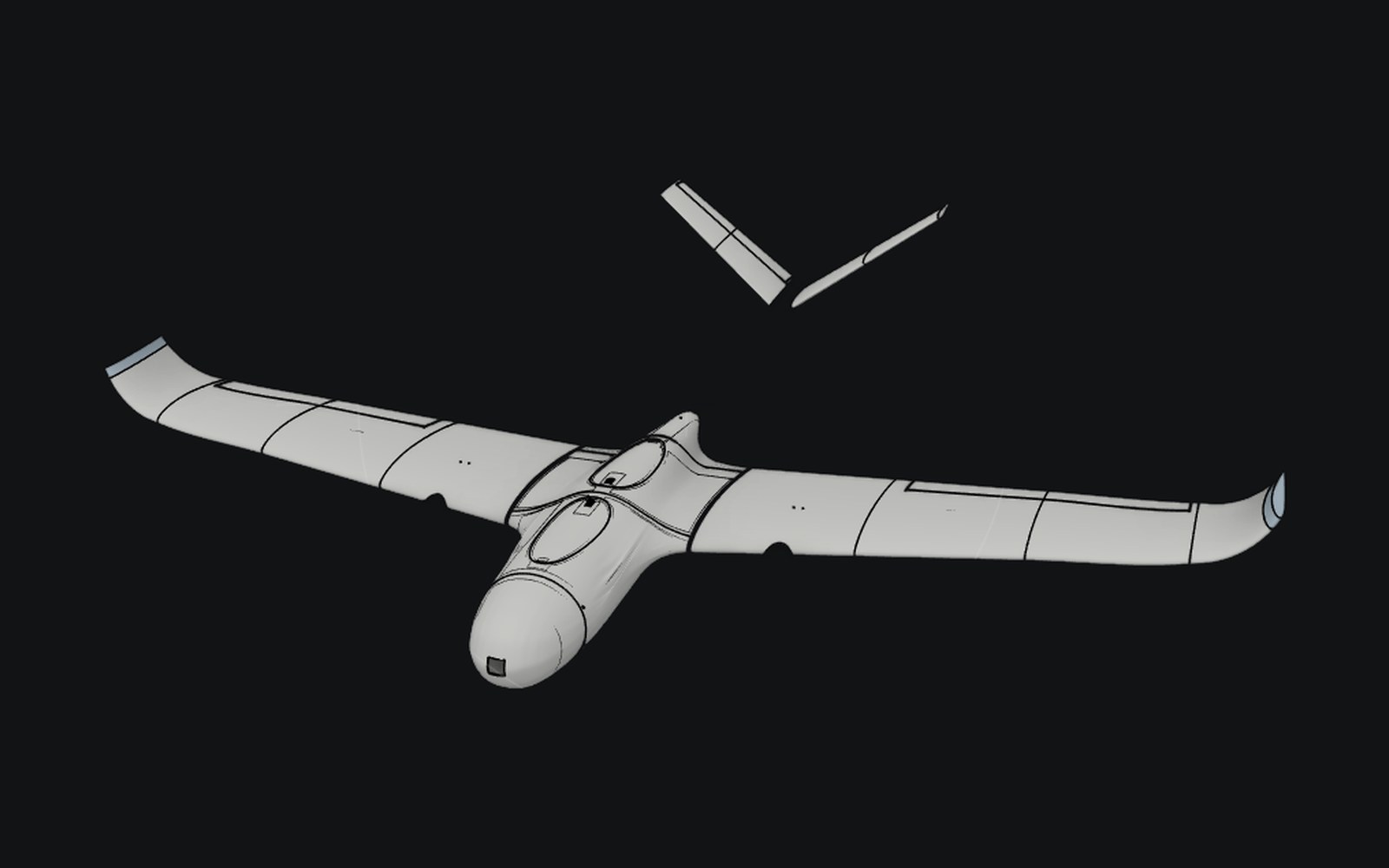
KS-01 from the front quarter. CAD render.
KS-01
A twin-motor, 3D-printed fixed-wing UAV with a blended wing-body, a carbon tail boom and a V-tail.
- Wingspan
- 1.60 m
- Take-off mass
- About 2.7 kg with a 4S2P Li-ion pack (design estimate)
- Wing area
- 0.385 m², aspect ratio 6.6
- Propulsion
- Two electric motors, 9-inch propellers
- Printed parts
- 54, plus a carbon tail boom
- Build volume
- At least 256 × 256 × 256 mm
- Materials
- LW-PLA skins, PETG mounts
- Cruise speed
- Published after flight testing
- Endurance
- Published after flight testing
Price announced at release
Get notified at launchKS-01 is not on sale yet. Files are released once the aircraft has been flight-tested.
One-off payment. Instant download by email. Checkout by Lemon Squeezy.
Sold under the personal-use licence.
KS-01 has not flown yet.
The figures on this page come from the CAD model and the sizing calculations behind it. Mass, balance and performance will be measured on the first airframe and this page updated before any files are sold. Details of the design can still change.
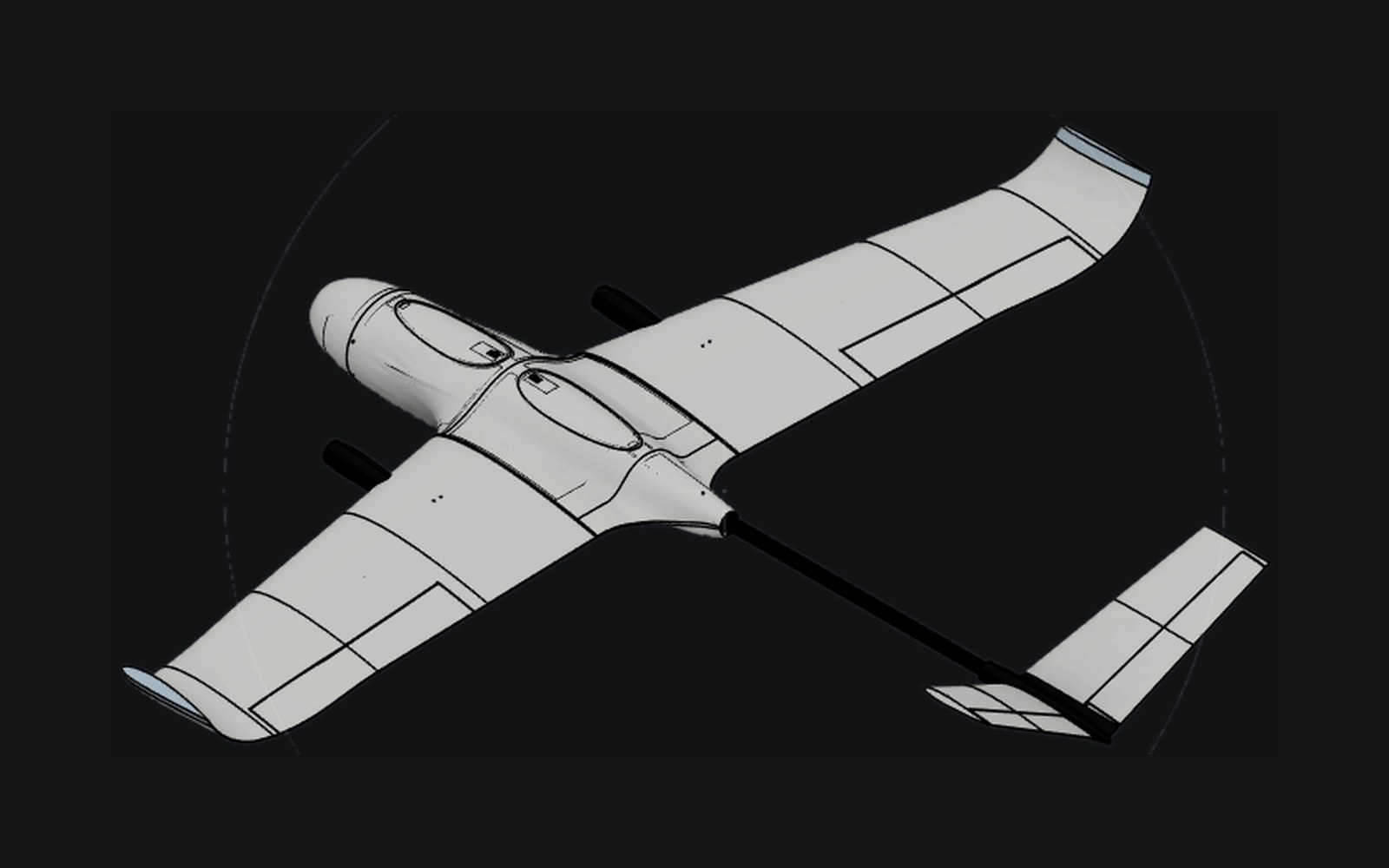
Look inside KS-01.
Turn the aircraft around, see through the skins, pull it apart, and find out where the battery, flight controller, motors and servos go.
- LW-PLA
- PETG
- PETG or TPU
- Carbon
- Clear PETG
[ About this model ] A simplified web model built from the KS-01 design geometry. Screw holes, wiring channels and latch details are left out, and the electronics themselves are not shown.
What you get.
Planned contents of the KS-01 release, confirmed here when sales open.
- [ STL ]
Print-ready STL files
Every printed part as its own STL, named and numbered to match the build manual.
- [ STEP ]
STEP files for key parts
Editable CAD for the parts people change most, such as the nose and equipment mounts.
- [ PDF ]
Build manual
Step-by-step assembly with drawings, the wiring diagram, balance point and control throws.
- [ CFG ]
Print settings
Tested slicer settings for each material, and the orientation for every part.
- [ BOM ]
Parts and hardware list
The carbon tubes, fasteners and electronics to buy, with sizes and quantities.
How it goes together.
54 printed parts, each sized for a 256 mm printer.
Skins print in lightweight foaming PLA. Anything that carries load or sits near a motor prints in PETG. Part names follow the current CAD model and may change during flight testing.
Fuselage23 printed parts
| Part | Qty | Material | Notes |
|---|---|---|---|
| Nose | ×1 | LW-PLA | Removable. Four M3 screws into the nose ring. |
| Fuselage sections 1 to 3 | ×3 | LW-PLA | Forward, centre and tail cone. Joined with filament alignment pins. |
| Hatch | ×2 | LW-PLA | Front and rear. Each sits on a ledge and hooks under the skin at one end. |
| Hatch latch: guide, slide and spring | ×6 | PETG | Two sets of three. |
| Nose ring | ×1 | PETG | |
| Spar box | ×1 | PETG | Carries both wing spars through the body. |
| Fuselage root plate | ×2 | PETG | Left and right. Spreads the wing load into the skin. |
| Battery tray | ×1 | PETG | |
| Flight controller plate | ×1 | PETG | 30.5 mm hole pattern. |
| Boom mount | ×1 | PETG | Carries the boom loads, so it prints solid. |
| Belly skid | ×4 | PETG or TPU | Two M3 screws each, so worn skids can be replaced. |
Wing22 printed parts
| Part | Qty | Material | Notes |
|---|---|---|---|
| Wing root rib | ×2 | PETG | Left and right. |
| Wing lock tongue | ×2 | PETG | Slides into the body and takes one M3 screw from under the wing. |
| Wing panels 1 to 3 | ×6 | LW-PLA | Three per side. |
| Wingtip | ×2 | LW-PLA | Upturned, with a pocket for the navigation light. |
| Navigation light lens | ×2 | Clear PETG | |
| Aileron, inner and outer | ×4 | LW-PLA | Two per side on a 3 mm hinge rod. |
| Servo cover | ×2 | PETG | |
| Motor nacelle | ×2 | PETG | Has to withstand motor heat. |
Tail9 printed parts
| Part | Qty | Material | Notes |
|---|---|---|---|
| Tail mount | ×1 | PETG | Holds both V-tail fins at the set angle. |
| V-tail panel, inner and outer | ×4 | LW-PLA | Two per side. |
| Ruddervator, inner and outer | ×4 | LW-PLA | Two per side on a 3 mm hinge rod. |
Carbon and hardware to buynot printed
| Item | Qty | Type | Notes |
|---|---|---|---|
| Tail boom | ×1 | Carbon tube | 20 mm outside diameter, cut to length. |
| Main wing spar | ×2 | Carbon tube | 10 mm outside diameter. |
| Rear wing spar | ×2 | Carbon tube | 8 mm outside diameter. |
| V-tail spar | ×2 | Carbon rod | 5 mm. |
| Hinge rod | ×4 | Carbon rod | 3 mm, for the ailerons and ruddervators. |
| M3 screws | Steel | Nose, wing locks and skids. Lengths and counts are in the build manual. |
Two materials do the work.
Skins: wings, fuselage, tail
Thin single-wall skins with no infill, and no top or bottom layers on the wing panels. The nozzle temperature sets how much the filament foams, so tune it with a test print and your spool’s datasheet.
Wing panels print standing on their root end.
Mounts: nacelles, spar box, boom mount
Three walls and 30 to 40% infill. Slower outer walls give better layer bonding where the loads are.
Motor nacelles must never be printed in PLA, which softens with heat.
[ In the download ] Tested slicer settings and the print orientation for every part.
What it is designed around.
You supply the electronics. Exact part numbers that have been flown in KS-01 are published with the build manual.
- Motors
- Two brushless motors turning 9-inch propellers, one in each wing nacelle
- Speed control
- One electronic speed controller per motor
- Battery
- 4S2P Li-ion pack on the battery tray, reached through a top hatch
- Flight controller
- Any board with a 30.5 mm mounting pattern
- Servos
- For the ailerons and the two ruddervators
- Radio
- Your own transmitter and a matching receiver
- Lights
- Optional navigation lights in the wingtips, with a wire channel through the wing
About KS-01.
When will the files be on sale?
After flight testing. Join the waitlist and you will get one email on the day sales open.
Will it fit my printer?
Every part fits inside a 256 × 256 × 256 mm build volume. Smaller printers, including 220 mm beds, will not fit the largest parts.
Can I change the design?
Yes, for your own builds. STEP files are included for the parts people modify most. You may not share or sell the files, changed or not.
Is there a VTOL version?
No. KS-01 is a conventional fixed-wing aircraft. It lands on replaceable belly skids.
Where does the design come from?
KS-01 is the worked example in Blueprint, the Kourashi Systems course in UAV systems engineering. Each module of the course makes one set of KS-01 design decisions.
Be first to get the files.
The Hangar opens for sales once KS-01 has been flight-tested. Leave your email and we will write to you once, on the day the files go on sale.
Thanks. You are on the waitlist.
We will email you when there is news on what you picked.